Author Barbara Kingsolver, in her The Poisonwood Bible, uses multiple points of view to tell the story of a family of missionaries that move to the Congo to missionvwork amidst a cloud of political turmoil. The points of view in this story cycle between the mother Orleanna, an her four children Leah, Adah, Ruth May, and Rachel, while skipping over the father’s point of view during the entirety of the novel. The multiple points of view allow the author to represent the family in almost every respect. Each daughter and the mother have their views equally characterized through their own point of view.
One author writes that multiple points of view “allows an author to piece together a complex story without requiring a single character to know and see everything” (Coe). I think this definitely applies to The Poisonwood Bible. Since there are so many characters and the back drop is set in the midst of a political revolution the story can become quite cloudy. By using the tool of having multiple points of view the author is able to show many different things in the story without giving away too much.
Also, I think that the multiple points of view allows the author to use subtlety in revealing different character details. For example, throughout Adah’s points of view we see her disability come into play while it goes unrecognized, for the most part, by the other sisters. For example, at the end of Adah’s first chapter in Genesis she says “It is true I do not speak as well as I can think. But that is true of most people, as nearly as I can tell” (Kingsolver 34).
Also, I think it’s very interesting how Kingsolver uses the multiple points of view for everyone except the father but is very good at giving a representation of the father through other points of view. For example, the reader is able to understand the father’s stubbornness through other’s such as when he stung by the plant after being told repeatedly that it would hurt him if he did not handle it right and when he repeatedly preaches to the tribes people, embarrassing them about their social normality.
Finally, one author says that multiple narration is usually used in documentaries and I find this very interesting because the novel itself almost reads as if it were a documentary and the women of the family are being interviewed (Love). Like in a interview documentary we only see what the girls choose to reveal to us and that makes the story itself more suspenseful as a whole.
Barbara Kingsolver’s The Poisonwood Bible is a classic example of novels that use multiple points of view. This multiple points of view allows the reader to maintain suspense throughout by not revealing everything all at once and only revealing what the characters choose to reveal. One very interesting thing in the novel that arises from the multiple points of view is the representation of the father who is portrayed perfectly without having a point of view himself. The novel is a great piece of literature and one of the only ones that is able to make multiple points of view work like clockwork.
Works Cited
Coe, David. “Point of View. Single VS Multiple.” January 5th 2009. Magical Words: Writing Tips and Publishing Advice for Aspiring Novelists. http://magicalwords.net/david-b-coe/point-of-view-single-vs.-multiple/
Kinsolver, Barbara. The Poisonwood Bible. Copyright 1998. Haprper Collins Publishers. New York City, New York.
Love, Tim. Multiple Points of View. Published January 2006. University of Cambridge. http://www2.eng.cam.ac.uk/~tpl/texts/multipovs.html
Friday, October 30, 2009

Friday, October 16, 2009
Cultural Icons: Bob Dylan & Allen Ginsberg
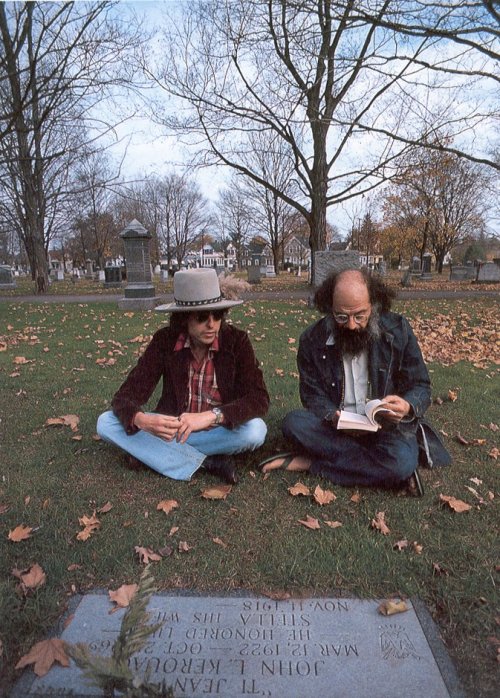
Bob Dylan’s music is reflective of political and cultural notions throughout the 1960’s to present day. Zit is undeniable that Dylan himself was influenced both in thought and in art by Allen Ginsberg and the rest of the beat generation. Dylan’s music is very similar to the work of Ginsberg in it’s themes and the feeling is mutual as Ginsberg himself has noted that Dylan’s music not only reflects his sentiments but inspires him as much as he inspired Dylan.
An obvious comparison to Dylan and Ginsberg are the political influences that flowed from Ginsberg. Take for instance Bob Dylan’s A Hard Rain’s A-Gonna Fall. This song is a political protest ot nuclear war and the reaction to the Cold War. On the other end Allen Ginsberg’s poem talk a lot about war morals and the cold war itself. For example, in Dylan’s song he says “I saw ten thousand talkers whose tongues were all broken, I saw guns and sharp swords in the hands of young children,” this line, amongst others, is a blatant response to those in power who are quicker to jump towards violence than reasoning (Dylan). To show where this influence could have stemmed from, we can look at Ginsberg’s “America” where he says “America, when will we end the human war? Go fuck yourself with your atom bomb” (Ginsberg) Both of these songs reflect the violent tendencies of America. Looking at examples directly from “Howl,” Ginsberg says in the opening lines “I saw the best minds of my generation destroyed by madness, starving hysterical naked, dragging themselves through the negro streets at dawn looking for an angry fix” (Ginsberg). This line seems to reference the “greatest minds of my generation” as government officials, and these ideas are mirrored in Dylan’s songs like “The Times They Are A-Changing” when Dylan says “Come senators, congressmen, please heed the call, don't stand in the doorway, don't block up the hall,” which mirrors similar intents of talking directly to those in power (Dylan).
This influence is not lost on Ginsberg either, he said once about Dylan “…It was the "Masters of War," I think, and ["A Hard Rain's A-Gonna Fall"]. And I was really amazed. It seemed to me that the torch had been passed, from Kerouac or from the beat genius on to another generation completely, who had taken it, and he'd taken it and made something completely original out of it, and that life was in good hands. I remember bursting into tears” (Ginsberg). Ginsberg’s recognition of Dylan embracing the culture that authors like himself and Kerouac built is quite evident. Not only does Ginsberg realize it but there seems to be a mutual respect between the two men.
It is safe to say that Bob Dylan’s entire career was heavily influenced by Allen Ginsberg and the rest of the Beats Generation. We can compare Ginsberg’s “Howl” to Dylan’s entire discography and see similarities in thought about culture and politics. And in the end, as much as Ginsberg influenced Dylan it becomes obvious that Bob Dylan did the same for Allen Ginsberg.
Dylan, Bob “A Hard Rain’s A-Gonna Fall,” The Freewheelin’ Bob Dylan. Columbia Recors, 1963.
Dylan, Bob “The Times They Are a Changing,” The Times They Are a Changing. Columbia Records, 1964. Tom Wilson
Ginsberg, Allen. Howl. City Light Books, San Francisco, CA. 1956
Zuckerman, Matthew. “If There's An Original Thought Out There, I Could Use It Right Now: The Folk Roots of Bob Dylan.” Dylan Influences. http://expectingrain.com/dok/div/influences.html. 20 February 1997.
Friday, October 9, 2009
Their Eyes Were Watching God: The Evolution of Janie
In Zora Neale Hurston’s Their Eyes Were Watching God, the protagonist Janie, goes through several phases throughout the duration of the novel. She changes from a young woman who is naïve and submissive to a woman who stands up for herself. Author Wendy J McRedie says that “Janie’s voice becomes the self actualizing voice of authority” (McCredie, 25). Janie goes from a submissive woman, both to the community and to her husband Jody, to a woman who doesn’t allow anyone but herself to influence her decision.
At the beginning of the novel, when Janie meets and marries Jody Starks, it is quite obvious that she is very submissive to her husband and lets him control her. One example of this submissive behavior comes early in the novel when Jody is named mayor and the town wants Janie to speak at a town meeting. Instead of letting Janie speak Jody interrupts and says “Mah wife don’t know nothin’ ‘bout no speech-makin,. Ah never married her for nothin’ lak dat. She’s uh woman and her place in de home” (Hurston, 43) This passage shows that Jodie is submissive to her husband and he has quite a bit of control over her life. The first half of the novel can be described as Janie desiring to have a voice in a world controlled by her husband who forces her to stifle her thoughts (McCredie, 27).
However, when Jody becomes sick Janie begins to change, she becomes braver and begins to speak out. Janie’s growth as a character and as a independent woman, begins to happen as Jody becomes ill and Janie realizes that she is able to escape from under the control of her husband. This can be seen as Jody lies on his death bed and Janie comes into see him, she tells him “You ain’t de Jody ah run off down de road wid. You’se whut’s left after he died. Ah run off tuh keep house wid you in uh wonderful way. But you wan’t satisfied wid me de way Ah was. Naw! Mah own mind had tuh be squeezed and crowded out tuh make room for your in mine” (Hurston 86). This shows that Janie is progressing as an individual and its no longer tolerant of having a man dominate her life.
Janie’s evolution and change as a character can be seen even further when she meets Tea Cake. After spending years with Jody, an abusive man, Janie is scarred and makes a decision to not allow herself to be dominated by him like she was with Jody. For example, after Tea Cake disappears and upsets Janie she responds by saying “Tea Cake, if you ever go off from me and have a good time lak dat and then come back heah tellin’ ,e how nice Ah is, Ah specks tuh kill yuh dead.” This is evidence that Janie is no longer going to let the men in her life walk all over her.
As the book continues Janie’s growth becomes more evident as she is able to fall in love with Tea Cake and they have a healthy loving relationship. However, the ending of the book is quite controversial. When Tea Cake gets rabies and tries to attack Janie she is forced to s hoot him. Some have interpreted this as being another act where a man attempts to stifle Janie, but I see it as the opposite, I see it as Janie finally growing enough to the point where she can firmly stand her ground against a man, even though it’s one she loves. The attack and shooting is not a message of dominance but the ending of a tragic romance. Author Jennifer Jordan writes “Tea Cake…falls in love with a lady, dedicates himself to making her happy, and sacrifices his life fighting the dragon” (Jordan)
This I ultimately shows how Janie’s growth has turned the tables, she has gone from a woman who was totally submissive to an oppressive husband to a woman who has a man she loves die for her.
Works Cited
Hurston, Zora Neale, Their Eyes Were Watching God. 1937. Harper Collins Publishers, 10 East 53r Street, New York, NY.
Jordan, Jennifer, “Feminist Fantasies: Zora Neale Hurston’s Their Eyes Were Watching God.” 1988. Tulsa Studies in Women’s Literature, Vol. 7, No. 1. Published by University of Tulsa.
McCredie. Wendy J., “Authority and Authorization in Their Eyes Were Watching God.” 1982. Black American Literature Forum, Vol. 16, No. 1. Published by St. Louis University.
At the beginning of the novel, when Janie meets and marries Jody Starks, it is quite obvious that she is very submissive to her husband and lets him control her. One example of this submissive behavior comes early in the novel when Jody is named mayor and the town wants Janie to speak at a town meeting. Instead of letting Janie speak Jody interrupts and says “Mah wife don’t know nothin’ ‘bout no speech-makin,. Ah never married her for nothin’ lak dat. She’s uh woman and her place in de home” (Hurston, 43) This passage shows that Jodie is submissive to her husband and he has quite a bit of control over her life. The first half of the novel can be described as Janie desiring to have a voice in a world controlled by her husband who forces her to stifle her thoughts (McCredie, 27).
However, when Jody becomes sick Janie begins to change, she becomes braver and begins to speak out. Janie’s growth as a character and as a independent woman, begins to happen as Jody becomes ill and Janie realizes that she is able to escape from under the control of her husband. This can be seen as Jody lies on his death bed and Janie comes into see him, she tells him “You ain’t de Jody ah run off down de road wid. You’se whut’s left after he died. Ah run off tuh keep house wid you in uh wonderful way. But you wan’t satisfied wid me de way Ah was. Naw! Mah own mind had tuh be squeezed and crowded out tuh make room for your in mine” (Hurston 86). This shows that Janie is progressing as an individual and its no longer tolerant of having a man dominate her life.
Janie’s evolution and change as a character can be seen even further when she meets Tea Cake. After spending years with Jody, an abusive man, Janie is scarred and makes a decision to not allow herself to be dominated by him like she was with Jody. For example, after Tea Cake disappears and upsets Janie she responds by saying “Tea Cake, if you ever go off from me and have a good time lak dat and then come back heah tellin’ ,e how nice Ah is, Ah specks tuh kill yuh dead.” This is evidence that Janie is no longer going to let the men in her life walk all over her.
As the book continues Janie’s growth becomes more evident as she is able to fall in love with Tea Cake and they have a healthy loving relationship. However, the ending of the book is quite controversial. When Tea Cake gets rabies and tries to attack Janie she is forced to s hoot him. Some have interpreted this as being another act where a man attempts to stifle Janie, but I see it as the opposite, I see it as Janie finally growing enough to the point where she can firmly stand her ground against a man, even though it’s one she loves. The attack and shooting is not a message of dominance but the ending of a tragic romance. Author Jennifer Jordan writes “Tea Cake…falls in love with a lady, dedicates himself to making her happy, and sacrifices his life fighting the dragon” (Jordan)
This I ultimately shows how Janie’s growth has turned the tables, she has gone from a woman who was totally submissive to an oppressive husband to a woman who has a man she loves die for her.
Works Cited
Hurston, Zora Neale, Their Eyes Were Watching God. 1937. Harper Collins Publishers, 10 East 53r Street, New York, NY.
Jordan, Jennifer, “Feminist Fantasies: Zora Neale Hurston’s Their Eyes Were Watching God.” 1988. Tulsa Studies in Women’s Literature, Vol. 7, No. 1. Published by University of Tulsa.
McCredie. Wendy J., “Authority and Authorization in Their Eyes Were Watching God.” 1982. Black American Literature Forum, Vol. 16, No. 1. Published by St. Louis University.
Friday, October 2, 2009
Feminism & Gertrude Stein
Gertrude Stein’s Tender Buttons displays feminism in various ways. Stein is a lesbian in a time when being a woman puts you in an already constructed gender role and homosexuality itself is a practice that is not welcomed by most of the country. Stein is able to advocate women’s rights and the views of feminist at the times by openly talking about female sexuality through her use of sexual imagery as well as being able to openly discuss her homosexuality.
One example of Stein’s frank discussion of women’s sexuality is the poem entitled A Box. Box is a rather crude slang term for a female anatomy. This poem alone is filled with sexual imagery and lines that can are almost certainly double entendres. One example of this sexual imagery comes late in the poem, “Left open, to be left pounded, to be left closed, to be circulating in summer and winter, and sick color that is grey that is not dusty and red shows,.” There are several images here that convey a sort of sexuality. The line “left to be pounded is a reference to sexual activity and words like “circulating” and “red” is almost certainly a reference to female anatomy. Another example of Stein’s overt sexual imagery comes through the poem Red Roses which reads “A cool red rose and a pink cut pink, a collapse and a sold hole, a little less hot.” The color red again references female anatomy as does other terminology she uses like “pink cut pink” and “a sold hole.” Gertrude Stein’s heavy references to female anatomy are a way in which she is able to express feminine ideals of sexual liberation in a time when women’s sexuality has been stifled.
Gertrude Stein was also a lesbian in a time that it was not okay for a person to announce themselves as a homosexual. Her sexual preference also plays a role in these poems which is another way in which Stein is able to make herself stand out as a feminist. For example, I read the poem “This is the Dress, Aider” as a sexual experience with another woman. She says things like “why whow, whow stop touch” and “stop the muncher, muncher munchers,” which seem again like crude references to sexual activity. These things sound like some sort of sexual experience, and knowing that Stein is in fact a lesbian and that a woman is referenced later in the poem leads me to believe that this entire poem is about Stein’s sexual encounters with another woman.
Feminism is a way in which women are able to liberate themselves from a suppressive society. Stein does this in her poem in a number of ways, namely in being able to have frank sexual imagery in her poems that create vivid images in her reader’s minds. Also, being a lesbian Stein is able to write about her homosexuality in an open way and this is another way in which women (both heterosexual and homosexual) are able to find freedom in a time of repression.
Friday, September 25, 2009
The Sun Also Rises: The Emasculated VS the Femme Fatale
The protagonists of Ernest Hemingway’s The Sun Also Rises, Jake Barnes and Lady Brett Ashley, represent gender in two very distinct ways, but both our represented through their sexuality. Barnes is for all intense and purposes a man who has lost his gender because of his war wounds and is searching for it throughout the novel. On the other hand, Lady Brett is a highly sexualized individual is searching for her gender by allowing herself to explore.
One way in which Jake tries to express his gender, and at this point is masculinity comes early in the novel when he goes to the dancing club and sees Lady Brett’s group of male friends, who are implied to be homosexual. Jake says “This whole show makes me sick,” referring to the homosexual men in attempt to display his masculinity (Hemingway, 29). Ira Elliot of Duke University says “Jake’s attitude toward the homosexuals-the way he degrades them and casts them as his rivals-will, I believe, reveal the extent to which sexual categories and gender roles are cultural constructions.” Not only are they cultural constructions but the gender roles become narrative constructions as well. At this point in the story we’ve already learned that Jake’s war wound has made him impotent, but it becomes clear at this point, even though for all intense and purposes he is a-sexual, he still holds onto the constructs of masculinity.
At the opposite end of the spectrum Lady Brett Ashley is searching for her gender role by being rather promiscuous. The role that she seeks is that of a lover and a partner to Jake, but the fallout from his war wound and the distance created thereafter makes their relationship quite volatile. One evident gender role in society is that of the femme fatale a woman who is desirable but represents the downfall of the men around her. I believe that Lady Brett is not trying to fulfill this gender role, but is quite aware herself that she is creating this entire scenario, even if by accident. In Chapter Sixteen Lady Brett says “I do feel such a bitch,” when Jake responds in concurrence, Lady Brett says “My God!....the things a woman goes through,” and seconds later repeats “Oh, I do feel such a bitch” (Hemingway It is as if Lady Brett realizes her own gender role as this femme fatale, but feels almost helpless to do anything about it.
Both Jake and Lady Brett are confined to their created gender roles but both feel almost helpless to do anything about it. Because of Jake’s war wounds he was been reduced to the role of a man who must display his masculinity and express his manhood in any other way he can. Lady Brett, who is in love with Jake and for all intense and purposes in love with sex, cannot be with Jake because he cannot perform. So because of this she has been reduced to a femme fatale role, where she almost becomes the downfall of multiple characters in the novel.
Both of the main protagonists, Lady Brett and Jake Barnes fall into traditional and stereotyped gender roles. Jake’s being one of a emasculated male figure who has to display dominance in other ways, and Lady Brett is a woman in love, whose desires that are not reciprocated force her into a femme fatale role. Both characters spend the entire novel in gender roles that outside circumstances have forced them into.
Works Cited
Hemingway, Ernest. The Sun Also Rises. 1926. Charles Scribner’s Son. 1230 Avenue of the Americas, New York, Ny 10020.
Thursday, September 3, 2009
The Scarlet Letter: Realism vs. Romanticism
Romanticism and realism are two very encompassing classifications of literature. Romanticism deals with idealistic views of the world, seen through symbolism and is often set in exotic locales. On the other hand realism has a very strict emphasis on morality and it’s place in society. Realism emphasizes the idea of character development being the most important factor while romanticism emphasizes the plot and the story. That being said, Nathaniel Hawthorne’s The Scarlet Letter uses ideas from both romanticism and realism.
The Scarlet Letter can be classified as Romanticism in several different aspects. First off the locale of The Scarlett Letter could very well be considered exotic. The small town is a speck of what seems to be idyllic land, in the midst of what the reader learns is an immoral forest and a world beyond that is even worse. While the setting itself seems benign the effects the surrounding area have on the town and it’s people make the location of the story very important. Romanticism also has a very heavy emphasis on symbolism, the letter itself being the most obvious. The letter, “A”, is a symbol of several things throughout the novel, the most apparent being that of adultery, since the letter is fond on both Hester’s clothes and Dimmsdale’s chest. However, the letter can also be interpreted as having several other meanings such as “alone” or “apostle” or as the townspeople decipher it when it appears in the sky “angel.”
A major aspect of realism is the idea of morality and how it’s interpreted. The issue of morals is at the forefront throughout the entire story. For example, Hester is accused, and admits to, adultery. This is how the reader is introduced to Hester and when Chillingworth, her husband who has been cheated on, is introduced it becomes evident that Hester is the one who evokes sympathy and emotions in the reader while Chillingworth is the one who is interpreted as the villain. It seems that the reader should be compassionate towards Chillingworth and have disdain for Hester, it is reversed and that is a very good example of how the issues of morality in realism are totally subjective.
However, the classification of romanticism is most heavily determined by the elements of the supernatural in the novel. While realism emphasizes elements based in reality romanticism has a strong emphasis in magic and supernatural occurrences. This can be seen throughout the novel, from the subtle to the very obvious. For example, it is hinted at several times in the start of the novel that Pearl may hold some sort of supernatural ability. For example, the text says that Pearl “seemed rather an airy sprite” (Hawthrone pg. 63).Also, the letter itself appears in supernatural contexts throughout the story. From its first appearance as an embroidery it is hinted that the letter itself is special. As the story progresses we see the supernaturalism of the letter grow, first appearing in the sky above the town and finally on Dimmsdale chest.
Nathaniel Hawthrone’s the Scarlet Letter has element s of both romanticism and realism. However, it becomes quite evident that the supernatural occurrences in the story are a contributing factor to the story’s classification as a romantic piece of literature.
Subscribe to:
Posts (Atom)